
From Aircraft Carriers to the Aviation Museum of New Hampshire
Lessons in Composure, Decision-Making, and History
A Change of Century—and Perspective
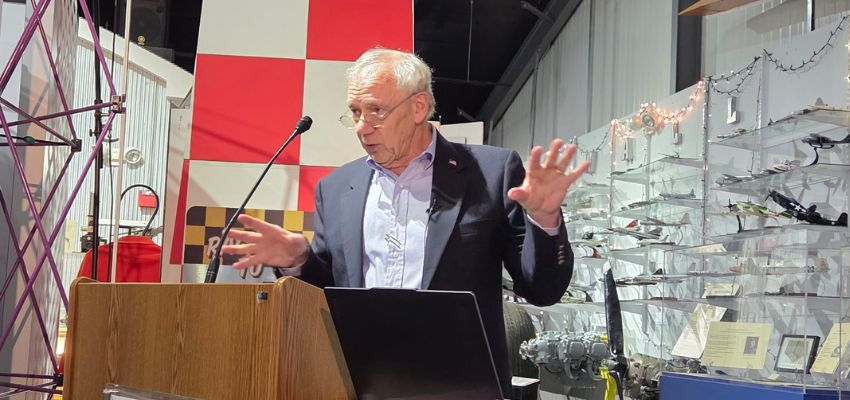
On March 26th, I took a brief and rather refreshing detour—from the crises of the third century to the controlled chaos of the twentieth. For an evening, I traded emperors for aviators and stepped into a different kind of history, speaking at the Aviation Museum of New Hampshire.
The setting itself was fitting. The museum is housed in the original Manchester Airport terminal, a place that has seen its share of departures, arrivals, and quiet moments in between. There’s something appropriate about telling stories of flight in a building that once witnessed the early days of it firsthand.
Life on the Edge of the Flight Deck
My talk covered several chapters of my aviation experience: operating on and off aircraft carriers, flying in Vietnam, and my time at the Naval Fighter Weapons School—better known as Top Gun.
Carrier operations are often described in technical terms—angles, speeds, glide slopes—but what stays with you is the intensity. You are bringing a fast-moving aircraft onto a small, moving deck, often at night, sometimes in rough seas, always with the understanding that things can go wrong quickly.
It is a discipline that rewards calm thinking—and punishes distraction.
Vietnam: Decisions Without Certainty
Flying in Vietnam added another layer entirely. The environment was unpredictable, the stakes were real, and the information available was often incomplete.
Decisions had to be made quickly, and sometimes with less certainty than anyone would prefer. It was a test not just of skill, but of judgment.
Top Gun: Where Learning Never Stops
Then there was Top Gun—a place designed to sharpen both.
It was less about bravado and more about learning: learning from mistakes, learning from others, and learning how to adapt. If there’s a single takeaway, it’s that excellence is not a fixed state but a process—one that requires constant adjustment.
From the Flight Deck to the Imperial Throne
As I spoke, it occurred to me that the distance between these experiences and my writing about Gallienus is not as great as it might seem.
Gallienus ruled during one of the most turbulent periods in Roman history, facing invasions, internal revolts, and systemic instability. His world demanded the same qualities: composure under pressure, the ability to act with incomplete information, and the resilience to continue despite setbacks.
In that sense, whether on a flight deck or an imperial throne, the challenge is remarkably similar—how to maintain clarity when everything around you suggests otherwise.
Visit the Aviation Museum of New Hampshire
The museum recorded the talk, and it should be available on their website soon.
If you have an interest in aviation or history, I would strongly encourage a visit. Beyond the exhibits, there is a sense of continuity there—a reminder that every generation faces its own version of challenge, innovation, and adaptation.
Final Thoughts: The Same Questions, Different Arenas
For me, the evening was a welcome change of century—but not a departure from familiar themes.
Whether writing about Rome or speaking about aviation, the underlying questions remain the same:
- How do people respond to pressure?
- How do they adapt?
- How do they endure?
Sometimes, the answers are found in history.
And sometimes, they’re found at the end of a runway—or just above the deck of a carrier.