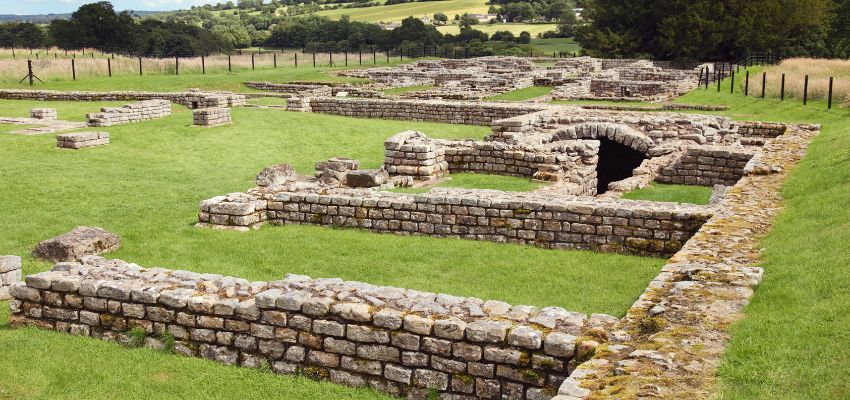

Permanent Camps: Seeds of Empire
Rome’s armies often began with temporary encampments, but many evolved into permanent installations. Along frontier zones—the Rhine, Danube, and Euphrates in particular—these became castra stativa, stationary forts that housed legions year-round. Their remains today form the cores of towns such as Chester (Deva Victrix), Vienna (Vindobona), and Strasbourg (Argentoratum).
Permanent camps were built in stone, often rectangular, with gateways aligned to the cardinal points. Inside stood barracks, granaries, workshops, headquarters buildings, temples to the standards, and commander’s houses. These strongholds guarded supply routes and provided staging bases for campaigns. Yet they all derived from the same model: the marching camp that every legionary knew how to build by heart.
The Marching Camp: Security in Routine
The castra aestiva—the marching or temporary camp—was the hallmark of Roman military discipline. At the end of each day’s march, no matter how exhausted the soldiers were, they stopped to construct it before resting. To outsiders, this seemed unnecessary labor. To the Romans, it was non-negotiable: security and order demanded it.
The routine had a psychological as well as practical value. The camp represented a piece of Rome transplanted into foreign soil, a secure and familiar grid of streets, gates, and ramparts that reminded soldiers who they were and what civilization they served.
Survey and Layout
Campsites were surveyed in advance by specialists. An officer of engineers, often the praefectus castrorum or a centurion of the first cohort, went ahead with a detail of soldiers carrying measuring rods and a groma—a cross-shaped instrument for laying out right angles.
The surveyor chose ground that was slightly elevated for drainage, near water but not too close to avoid flooding, and open enough to allow clear lines of sight. The space had to accommodate the entire force: roughly 50 acres for a full legion of 5,000 men and their auxiliaries.
Once selected, the site was marked out with flags or stakes defining the central axis (the via praetoria) running from the main gate to the commander’s tent (praetorium). From this spine extended the via principalis, dividing the camp into distinct zones—command, troops, and supply.
The Ditch and Rampart
With the plan set, the digging began. Every soldier carried a shovel (dolabra), a pick, and a basket or leather sling for carrying earth. The first task was the fossa, a trench cut around the perimeter. Dimensions varied with the threat level: a shallow ditch for peaceful provinces, a deep and wide moat if enemies were near.
The excavated soil was thrown inward to form the agger, a raised earthen rampart. This mound, compacted by foot and shovel, stood shoulder-high or higher, forming the camp’s wall. The inner face was smoothed, and the outer often sharpened into a sloping bank to impede attackers.
Into the top of this mound went the stakes—pointed wooden poles (valli) each soldier carried bundled with his gear. They were driven in at angles to form a continuous palisade. When viewed from outside, even a one-night camp looked like a fortified town, bristling with sharpened timber.
Entrances and Streets
The typical camp had four gates aligned with the cardinal points: porta praetoria (front), porta decumana (rear), and two side gates (principalis dextra and principalis sinistra). Each was angled or staggered to prevent a direct rush by the enemy.
Inside, the streets were laid out in strict grids. The commander’s tent stood in the center, beside the altar and standards—the symbolic heart of the legion. Around it were the officers’ quarters and the administrative tent where pay, rosters, and orders were kept.
To the rear and sides stretched rows of century tents: ten to a cohort, eight men per tent. The uniform spacing allowed quick movement even in the dark. Workshops, stables, kitchens, and the quaestorium (supply depot) occupied assigned corners. The latrines, always downhill, were dug at the same distance from camp in every direction.
The Rhythm of Construction
Archaeologists and historians, from Polybius to Hyginus Gromaticus, describe the rhythm of this nightly labor. Once the signal was given, centuries divided tasks with clockwork precision. Some felled trees for stakes and firewood; others measured the ditch; still others pitched tents within the marked lines.
An entire camp could rise in under three hours. To the modern observer, it was like watching a city appear at sunset and vanish at dawn. When the legion broke camp, soldiers filled in the trench and erased their traces—a precaution against pursuit or contagion from past battles.
Order, Morale, and Symbolism
The temporary camp was more than a military precaution; it was a reflection of Roman ideology. The grid echoed the street plan of Roman colonies and the field systems of Italian farms. It turned wilderness into civilization, chaos into order.
Every repetition reinforced discipline. A man who knew where his tent, his armor, and his tools went was less likely to panic in battle. Even the monotony had value: the act of building camp after camp ingrained obedience deeper than any parade ground drill.
Evidence in the Archaeological Record
Across Europe, traces of these camps survive as faint ditches, discolorations in soil, or low ridges visible only from the air. In Scotland, the footprints of temporary camps built during Agricola’s campaigns form neat rectangles miles apart. Their identical dimensions prove the Roman preference for standardization: each measured roughly 20 hectares, regardless of terrain.
Legacy
The Roman marching camp influenced European military engineering for centuries. Medieval armies copied its rectangular enclosures; early modern field fortifications owed much to its design. The very word encampment carries the Roman concept of a structured temporary habitat.
In many ways, the Roman camp was a portable Rome—a disciplined microcosm of the city itself. Every time a legion pitched tents, it carried with it not just soldiers but the habits of a civilization convinced of its destiny to impose order on the world.
This article was developed with the assistance of ChatGPT, an AI language model by OpenAI