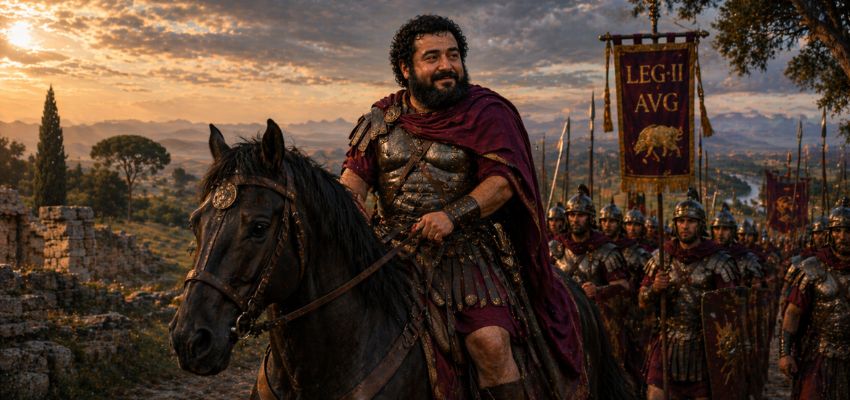

When we think of the Roman Empire, we imagine a monolithic power stretching from Britain to Egypt. But in the 3rd century AD, Rome fractured. One of the most remarkable breakaway states was the Gallic Empire, a short-lived yet significant rival that revealed just how fragile Roman unity had become.
The Birth of a Breakaway Empire
The Gallic Empire was born in AD 260, in the aftermath of Valerian’s capture by the Persians and during Gallienus’ desperate struggle to hold the center together. In Gaul, Hispania, and Britain, loyalty wavered. Facing constant barbarian invasions and frustrated by Rome’s inability to defend them, local commanders and elites declared independence under Postumus, a talented general who styled himself emperor.
What It Controlled
At its height, the Gallic Empire included:
– Gaul (modern France and surrounding regions)
– Britain
– Parts of Hispania
Though cut off from Rome, it mimicked the imperial system: issuing coins, appointing officials, and defending borders. To many in the west, Postumus must have seemed more capable of protecting them than Gallienus far away in Italy.
Why It Mattered
The Gallic Empire highlights both the weakness and resilience of Rome in the 3rd century. Weakness, because the empire’s far-flung provinces no longer trusted central leadership. Resilience, because even in secession, Roman traditions endured. Postumus didn’t claim to overthrow Rome — he claimed to preserve it in the west. His empire still looked and felt Roman, even if it was politically separate.
Gallienus’ Dilemma
For Gallienus, the Gallic Empire was a bitter blow. He desperately needed unity, but he couldn’t afford to march west and crush Postumus while facing invasions and usurpers elsewhere. The empire’s fragmentation was both symptom and cause of the crisis: Rome was simply stretched too thin.
The End of the Experiment
The Gallic Empire lasted for about fifteen years, with several rulers after Postumus. Eventually, Emperor Aurelian reunited the west with the rest of the empire in AD 274. But the very fact that it survived so long speaks volumes about the strain of the age.
My Takeaway as a Writer
The Gallic Empire fascinates me because it shows how fragile “Rome” really was. It wasn’t just external enemies that threatened the empire; it was also the pull of local identity, loyalty, and survival. Writing about this episode reminds me that unity is never guaranteed — it must be constantly maintained, often at enormous cost.
Reader’s Corner
Do you see the Gallic Empire as a betrayal of Rome, or as a creative attempt to survive when the central government failed?
This article was developed with the assistance of ChatGPT, an AI language model by OpenAI