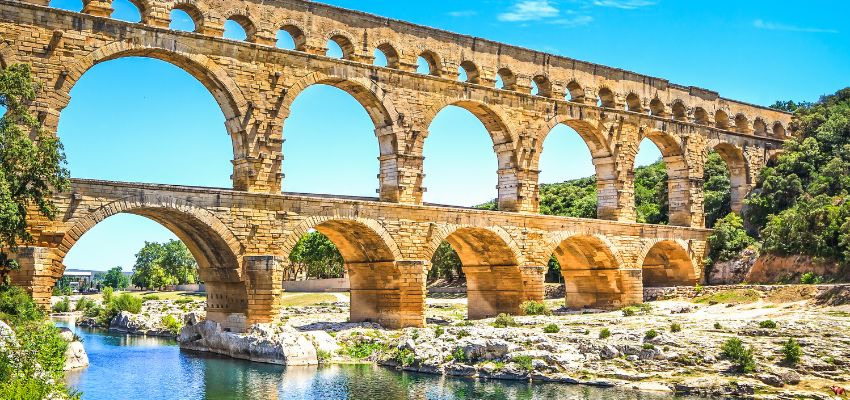

The Roman Empire is often celebrated for its military prowess, political organization, and monumental architecture, but one of its most enduring legacies is in the field of civil engineering: the aqueduct. These structures—part architecture, part utility—were feats of ingenuity that supplied cities, baths, fountains, and private households with fresh water. The aqueduct system was more than just a marvel of construction; it was a lifeline that made urban life possible on a scale unmatched until the modern era.
Origins and Historical Development
Aqueducts were not an entirely Roman invention. The idea of channeling water from distant sources was practiced earlier by civilizations such as the Assyrians, Babylonians, and Greeks. The Etruscans, from whom the Romans borrowed many engineering concepts, also built primitive water channels. However, it was the Romans who perfected the technique and applied it on a massive scale.
The first Roman aqueduct, the Aqua Appia, was constructed in 312 BCE under the censorship of Appius Claudius Caecus (who also built the Via Appia). Over the following centuries, the network expanded dramatically. By the 3rd century CE, Rome alone was supplied by eleven major aqueducts with a combined length of hundreds of kilometers. Provincial cities across the empire—from Nîmes in Gaul to Segovia in Hispania—also built their own aqueduct systems.
Sources of Water
Roman aqueducts typically drew water from natural springs in the countryside. Springs were ideal because they provided a steady, clean, and gravity-fed supply. Occasionally, rivers or reservoirs were used, but only when water quality and flow could be controlled. Surveyors (gromatici) played a crucial role in selecting sources, balancing distance, altitude, and purity.
Surveying and Route Planning
The aqueduct’s success hinged on precision surveying. Roman engineers had to maintain a very gentle slope—often less than 1 meter of fall for every 300 meters of length—to allow gravity to move water smoothly without stagnation or damaging erosion. Tools like the chorobates (a type of level) and dioptra (similar to a theodolite) enabled them to measure gradients with remarkable accuracy.
Routes often meandered to avoid hills or valleys, but when possible, they were kept as straight as terrain allowed. In mountainous areas, tunnels were bored; in valleys, bridges or arcades were constructed.
Construction Methods and Materials
A Roman aqueduct was not a single type of structure but a combination of engineering solutions depending on terrain:
1. Underground Conduits – Most of an aqueduct’s length was underground, both to protect the water from contamination and to minimize exposure to weather or enemy sabotage. These channels were lined with stone, brick, or concrete (opus caementicium) and coated with waterproof mortar (opus signinum).
2. Arcades (Bridges of Arches) – Where the route crossed valleys or uneven ground, engineers built elevated arcades, often in multiple tiers. Famous examples include the Pont du Gard in France and the Aqueduct of Segovia in Spain. Arches minimized the amount of material needed while providing stability.
3. Tunnels – When a hill lay in the aqueduct’s path, tunnels were dug. Workers often excavated from multiple shafts to speed construction, meeting in the middle with impressive accuracy.
4. Syphons – In rare cases, Romans used inverted syphon systems: a series of pipes (often lead, stone, or terracotta) that carried water down into a valley and back up the other side, relying on hydraulic pressure.
The primary building material was opus caementicium, Roman concrete, which could be poured into wooden forms and hardened to a durable mass. Brick and stone were also used for structural strength and to create smooth internal surfaces.
The Water Channel (Specus)
The specus was the conduit in which the water flowed. In underground sections, it was often a vaulted tunnel about 1–2 meters high, allowing maintenance crews to enter. The floor was slightly inclined, and the interior was plastered to prevent leaks. In elevated sections, the channel was lined with similar waterproof materials and covered to keep debris out.
Distribution in the City
Upon reaching the city, aqueduct water was collected in a castellum divisorium—a distribution tank. From there, it was channeled through a network of lead, ceramic, or occasionally bronze pipes to various destinations:
• Public Fountains – Providing free access to clean water for the population.
• Bathhouses – Rome’s famous thermae consumed enormous volumes daily.
• Private Homes – Wealthy citizens could pay for direct connections to the water supply.
• Industrial Uses – Mills, dye works, tanneries, and other enterprises used aqueduct water for production.
Roman law regulated the allocation of water and prohibited unauthorized tapping of aqueduct lines.
Maintenance and Management
Aqueducts required constant upkeep. The curator aquarum, a high-ranking official, oversaw water supply and maintenance crews. Laborers cleared blockages, repaired leaks, and replaced sections of pipe. Sedimentation tanks removed debris before water entered the main system.
Roman engineers understood that neglected aqueducts could become clogged with lime deposits or contaminated. Some aqueducts had inspection shafts at intervals, allowing crews to clean and repair them.
Utilization and Impact on Roman Life
Aqueducts enabled the urbanization of the empire on a scale previously impossible. They allowed cities to grow beyond the limits of local wells or rainwater cisterns. Public baths, fountains, and even ornamental water features flourished because of abundant supply. Fresh water also contributed to improved sanitation—although Romans still lacked a modern understanding of germ theory, they did recognize the health benefits of clean, plentiful water.
The aqueducts were as much political symbols as they were practical utilities. Emperors who built or repaired them advertised their generosity and engineering prowess. Inscriptions proudly recorded who commissioned and funded each project.
Decline and Legacy
With the fall of the Western Roman Empire in the 5th century CE, many aqueducts fell into disrepair due to neglect, war, or the disruption of skilled labor networks. Some were deliberately destroyed by invading armies to deprive cities of water. In Rome, the population shrank dramatically, reducing the need for such extensive infrastructure.
However, many aqueducts—or parts of them—remained in use for centuries. In some cases, medieval towns restored and adapted Roman structures for their own needs. Modern water systems often trace their routes to ancient lines.
Today, aqueducts like the Pont du Gard, the Aqua Claudia, and Segovia’s aqueduct still stand as striking monuments to Roman engineering. They are studied not only as archaeological treasures but also as practical lessons in sustainable gravity-fed water distribution.
Engineering Principles that Endure
Even in the 21st century, the basic Roman approach—careful surveying, gravity flow, durable construction—remains relevant. While modern systems rely on pumps and pressurized pipes, rural aqueducts in some parts of the world still function much like their Roman predecessors.
Their endurance is a testament to the combination of practicality, adaptability, and aesthetic sense that defined Roman engineering. An aqueduct was not just a utility but an embodiment of Rome’s ability to bend nature to human needs without losing sight of form and harmony.
Ancient Rome’s water and waste management systems were among the most advanced in the ancient world, reflecting both engineering skill and a civic commitment to public health, convenience, and urban growth. The Romans understood that a thriving city required reliable access to clean water and effective removal of waste — and they built infrastructure on a scale unmatched until modern times.
Water Supply and Aqueducts
Rome’s population at its peak may have exceeded one million people, far surpassing the capacity of local springs and the Tiber River to supply clean water. Beginning in the 4th century BCE, the Romans constructed aqueducts — remarkable feats of engineering that transported water from distant sources, often tens of miles away, into the city. By the imperial period, Rome was served by at least eleven major aqueduct systems, such as the Aqua Claudia and Aqua Marcia. These structures combined underground conduits, pressurized lead or terracotta pipes, and monumental stone arcades to carry water over valleys.
Water was distributed to public fountains, baths, ornamental pools, and private homes (for those wealthy enough to afford a direct connection). Public fountains ensured that even ordinary citizens had free access to clean water, a point of civic pride and a critical safeguard against disease.
Urban Distribution and Public Baths
The water supply fueled one of Rome’s most famous social institutions: the public baths. Facilities like the Baths of Caracalla could accommodate thousands daily, offering not just bathing but exercise, libraries, and gardens. Aqueducts also supplied naumachiae (artificial lakes for mock naval battles), irrigation for gardens, and water features in villas and temples. This abundant water use would have been impossible without Rome’s efficient supply systems.
Sewers and Waste Removal
Just as important as delivering clean water was the removal of dirty water and waste. Rome’s sewer system, most famously the Cloaca Maxima (“Great Sewer”), began as an open drainage canal in the 6th century BCE and evolved into a covered stone tunnel still partially in use today. The system drained stormwater and wastewater from streets, public latrines, and bathhouses into the Tiber.
Public latrines were often large, communal spaces with stone benches lined with keyhole-shaped openings, beneath which flowed a continuous stream of water to carry away waste. A separate gutter in front of the seats supplied water for sponges-on-sticks (tersoria) used for personal cleaning — the ancient equivalent of toilet paper. While private homes often relied on cesspits or chamber pots, wealthier residences could be connected to the sewer network.
Challenges and Limitations
Despite its sophistication, the Roman system had limitations by modern hygiene standards. Raw sewage was discharged directly into the Tiber without treatment, polluting the river. Lead piping, though common, posed potential health risks, though the scale of lead poisoning is debated. Furthermore, the system relied heavily on gravity; blockages, flooding, and maintenance demands were constant concerns.
Legacy
Rome’s water and septic systems set engineering benchmarks that influenced urban planning for centuries. The aqueducts demonstrated the value of long-distance water transport, while sewer networks proved the importance of coordinated waste removal. Medieval Europe, after Rome’s fall, largely lost these large-scale systems, underscoring how exceptional they were in antiquity. Today, remnants of Rome’s aqueducts and sewers still stand — silent testimony to a civilization that recognized that clean water in and dirty water out was the foundation of a great city.
This article was developed with the assistance of ChatGPT, an AI language model by OpenAI